According to CoinShares, crypto investment products experienced weekly inflows of $160 million, the largest since July 2022.
On March 27, European cryptocurrency investment firm CoinShares published its “Digital Asset Fund Flows Report,” which revealed that digital assets continue to attract investors' attention as concerns over the stability of traditional finance (TradFi) continues to grow.
According to the latest report, investment products in digital assets experienced inflows of $160 million last week, the largest since July 2022, marking a significant reversal after six weeks of outflows totaling $408 million. The report also noted that “while the inflows came relatively late compared to the broader crypto market,” investors are increasingly concerned about the stability of the traditional finance sector.
Investments came from various countries, including the United States, Germany, and Canada, with inflows of $69 million, $58 million, and $26 million, respectively.
According to the report, Bitcoin (BTC) products received inflows of $128 million due to clients viewing it as a "safe haven" for the first time. However, not all investors shared this view, as short-Bitcoin products also saw inflows of $31 million. Nevertheless, short-Bitcoin remains the investment product with the most inflows year-to-date, though it is not the best-performing product from a price perspective.
On the other hand, Ether (ETH) products experienced outflows of $5.2 million last week, marking the third consecutive week of outflows. The report attributes this trend to investor anxiety over the Shanghai upgrade, expected to occur on April 12. Various altcoins also saw inflows, with Solana (SOL), Polygon (MATIC), and XRP products attracting $4.8 million, $1.9 million, and $1.2 million, respectively.
Overall, the report cited rising concerns over the stability of traditional finance as the reason for the growing interest in digital assets, as many investors are starting to view the sector as a "safe haven."
Additionally , over the last couple of weeks, many investors have rotated their portfolio investments due to the banking crisis, which has resulted in the sending of over $286 billion into United States money market funds so far in March, according to Emerging Portfolio Fund Research (EPFR) data obtained by the Financial Times.
The influx of money into money market funds can be attributed to concerns about the stability of the financial system, as banks in the U.S. and Europe are experiencing liquidity constraints due to tightening monetary policies. During times of uncertainty, money market funds are a preferred investment option for many as they offer high liquidity and low risk. Presently, these funds are providing some of the best yields in years due to the continuous interest rate hikes by the U.S. Federal Reserve aimed at curbing inflation.
from Cointelegraph.com News https://ift.tt/jCz9OK3
Meanwhile, the supply of XRP held by addresses with a balance between 10 million and 100 million tokens has risen by over 1% since February. That coincides with a 0.75% drop in the XRP supply held by the 1 million-10 million address cohort.
XRP balance in addresses holding between 1,000 and 100 million tokens. Source: Santiment
The addresses holding between 1,000 and 1 million XRP also increased their token holdings in the same period. That shows the XRP whales stacked up more tokens in the days leading up to the ruling on SEC vs. Ripple's so-called summary judgment.
Multiple observers, including legal expert John Deaton, see Ripple winning the case, arguing that the SEC may have failed to give the company a "fair notice" before suing it for committing securities fraud.
I have no doubt Ripple will win and the current Supreme Court will shut down the @SECGov’s gross overreach. The West Virginia EPA case is all you need to read to agree with me. @Ripple’s summary judgment brief is already an extremely well written appellate brief. https://t.co/o3g9zML9S2
In recent months, Analisa Torres, the federal judge overseeing the lawsuit, has also favored Ripple on various motions. For instance, she has approved Ripple's demand that the SEC makes its internal emails and documents regarding cryptocurrencies public, which may prove that the regulator unfairly targeted the company.
25% XRP price pullback in April?
From a technical perspective, the XRP/USD rally has brought the pair near a resistance confluence zone, which may lead to bearish reversal in the coming weeks.
The confluence comprises of a multi-year descending trendline (black), a 200-3D exponential moving average (200-3D EMA; the blue wave) and a support-turned-resistance horizontal level at around $0.50 (purple).
In the case of a pullback, the XRP price's next downside target appears at its multi-month ascending trendline support (black) around $0.35, down about 25% from current price levels.
On the other hand, a breakout above the descending trendline will have XRP price eyeing $0.60 as the next upside target.
This level has served as support in December 2021 and January 2022 — and as resistance in the September-October 2022 session. It is also the target of a prevailing bull pennant structure.
This article does not contain investment advice or recommendations. Every investment and trading move involves risk, and readers should conduct their own research when making a decision.
from Cointelegraph.com News https://ift.tt/mwHG74s
The cryptocurrency exchange and its founder, Changpeng Zhao, have allegedly violated trading and derivatives rules.
The United States Commodity Futures Trading Commission has filed suit against Binance and CEO Changpeng “CZ” Zhao for trading violations, according to a Bloomberg report. The suit was filed in the U.S. District Court for the Northern District of Illinois.
According to the CFTC, Binance failed to meet its regulatory obligations by not properly registering with the derivatives regulator. The cryptocurrency exchange has been the focus of a CFTC investigation since 2021. The exchange acknowledged in February that it would likely face regulatory action in the United States and was already working with regulators.
In addition to the CFTC, Binance has been under investigation by the Internal Revenue Service and federal prosecutors, who have examined the exchange’s adherence to Anti-Money Laundering rules. Meanwhile, the Securities and Exchange Commission has been investigating whether Binance allowed U.S. traders to access unregistered securities.
Binance is the biggest cryptocurrency exchange with over $8.5 billion trading volume daily.
This is a developing story, and further information will be added as it becomes available.
from Cointelegraph.com News https://ift.tt/bdYi0KO
Many investors have rotated their portfolio investments due to the banking crisis in the past two weeks, injecting billions of dollars on money market funds in the United States.
The banking crisis has led many investors to rotate their portfolio investments in the past two weeks, sending over $286 billion into United States money market funds so far in March, according to EPFR data obtained by the Financial Times.
The top winners from investors flooding cash into US money market funds in the past two weeks are Goldman Sachs, JPMorgan Chase, and Fidelity, according to the figures. Goldman Sachs' money funds have received $52 billion, a 13% growth, while JPMorgan's funds poured almost $46 billion and Fidelity saw inflows of nearly $37 billion, says the FT. The volume of inflows is the biggest for a month since the emergence of the Covid-19 outbreaks.
A money market fund commonly offers high liquidity and low risk, which makes them a popular option for investors during uncertain times. Currently, these funds are offering its best yields in years as the U.S. Federal Reserve keeps raising interest rates to curb inflation.
Money Market Fund Assets. Source: Investment Company Institute
Over a period of seven days ending on March 22, the total money market fund assets increased by $117.42 billion to $5.13 trillion, according to a report from the Investment Company Institute. Among taxable money market funds, government funds increased by $131.84 billion and prime funds dropped by $10.83 billion. Tax-exempt money market funds shrank by $3.61 billion.
Money market funds inflows are driven by fears surrounding the financial system health as banks in the US and Europe face liquidity constraints amid monetary policy tightening.
On March 24, Deutsche Bank shares dropped due to an increase in the cost of insuring against its potential default risk. The German bank’s five-year credit default swaps, known as CDS, climbed 19 basis points (bps) from the previous day, closing at 222 bps, according to Reuters, which cited S&P Global Market Intelligence data.
In the United States, uncertainty still looms over regional banks as insurance on default for financial services firms Charles Schwab and Capital One soared last week, with the latest seeing credit default swaps jump over 80% to 103 bps as of March 20.
BREAKING: Credit Default Swaps (CDS), insurance on default on Charles Schwab EXPLODE pic.twitter.com/KJdNTq2xMm
Bitcoin price is making another run at $28,000 and this is luring altcoin traders into XRP, LTC, XMR and AVAX positions.
The recent banking crisis in the United States seems to have shaken the belief of some customers in the legacy banking system. According to Federal Reserve data, customers pulled nearly $100 billion in deposits in the week ending March 15.
American venture capital investor and entrepreneur Tim Draper said in a March 25 report that “founders need to consider a more diversified cash management approach” due to the over-regulation of banks and micromanagement by the government. As part of a contingency plan, Draper suggested businesses keep “ at least 6 months of short-term cash in each of two banks, one local bank and one global bank, and at least two payrolls worth of cash in Bitcoin (BTC) or other cryptocurrencies.”
The move from the traditional banking system to cryptocurrencies may have already started as seen from the strong showing of Bitcoin in the past few days. Even after the recent up-move, investors do not seem to be hurrying to book profits in Bitcoin. However, the same cannot be said about most altcoins as they have witnessed a minor pullback.
In the short term, traders need to be selective of the cryptocurrencies to trade. Let’s study the charts of Bitcoin and select altcoins which may start the next leg of the up-move.
Bitcoin price analysis
Bitcoin has been hovering around the $28,000 level for the past few days. A consolidation after a strong rally is a positive sign as it shows that traders are holding on to their position, expecting a further up-move.
BTC/USDT daily chart. Source: TradingView
The upsloping 20-day exponential moving average ($25,936) and the relative strength index (RSI) in the positive area suggest the bulls remain in control. That enhances the prospects of a break above $28,900.
If that happens, the BTC/USDT pair could rally to the $30,000 to $32,000 resistance zone. The bears will try to defend this zone with all their might because if they fail in their endeavor, the pair may skyrocket to $40,000.
The vital support on the downside is $25,250. If this level fails to hold up, the pair may tumble to the 200-day simple moving average ($20,179).
BTC/USDT 4-hour chart. Source: TradingView
The 4-hour chart shows that the pair has been trading in a range between $26,500 and $28,900 for some time. The 20-EMA is flat and the RSI is just above the midpoint, indicating a balance between supply and demand.
A break above $28,900 will signal that bulls have overpowered the bears. That will indicate the resumption of the up-move. On the contrary, if the price breaks below $26,500, the pair may tumble to $25,250 and then to $24,000.
XRP price analysis
XRP (XRP) soared above the overhead resistance of $0.43 on March 21. The bears tried to trap the aggressive bulls by pulling the price below the moving averages but the bulls held their ground.
XRP/USDT daily chart. Source: TradingView
Buyers are trying to push the price toward the overhead resistance at $0.51. If bulls clear this obstacle, the ETH/USDT pair could attempt a rally to $0.56. This level is likely to witness aggressive selling by the bears but if buyers bulldoze their way through, the next stop may be $0.80.
Another possibility is that the price turns down from $0.51. During the pullback, if bulls flip the $0.43 level into support, it will suggest that the sentiment has turned positive. That will increase the likelihood of a break above $0.51.
The crucial support to watch on the downside is $0.40. If this level gives way, the next support is $0.36.
XRP/USDT 4-hour chart. Source: TradingView
The 4-hour chart shows that the bears are trying to defend the 61.8% Fibonacci retracement level at $0.46 and the bulls are buying the dips to the 20-EMA. This shows a state of equilibrium between the bulls and the bears.
If the price sustains above $0.46, it will suggest that bulls have seized control. The pair could then attempt a rally to $0.49 where the bears may again mount a strong defense. On the other hand, if the price slips below the 20-EMA, the pair may fall to $0.43 and then to $0.40.
Litecoin price analysis
While most major altcoins are struggling to start a recovery, Litecoin (LTC) is showing signs of strength. The 20-day EMA ($86) has started to turn up and the RSI is in the positive zone, indicating advantage to buyers.
LTC/USDT daily chart. Source: TradingView
The LTC/USDT pair could first rise to $98 and then retest the strong overhead resistance at $106. This is an important level to keep an eye on because if it crumbles, the pair may accelerate to $115 and then to $130.
Alternatively, if the price turns down sharply from $106, it will suggest that bears are active at higher levels. The pair could then drop to the 20-day EMA. If the price rebounds off this level, it will suggest that the sentiment remains positive. The bulls will then make another attempt to resume the up-move.
The first sign of weakness will be a break and close below the 20-day EMA. That could open the doors for a drop to $75.
LTC/USDT 4-hour chart. Source: TradingView
The rebound off the 20-EMA on the 4-hour chart shows that the bulls are viewing the dips as a buying opportunity. The bulls will try to kick the price above $96 and extend the up-move to the overhead resistance at $106.
Contrarily, if the price breaks below the 20-EMA, it will suggest that the bullish momentum is weakening. The pair could then descend to the uptrend line. This is an important level for the bulls to defend because if it cracks, the pair may tumble to $75.
After trading near the moving averages for a few days, Monero (XMR) has broken free and is trying to climb higher.
XMR/USDT daily chart. Source: TradingView
The 20-day EMA ($153) has started to turn up and the RSI is in the positive territory, indicating that buyers have the edge. There is a minor resistance at $170 but if bulls overcome this barrier, the XMR/USDT pair could pick up momentum and soar to $187 and subsequently to $210.
The moving averages are expected to provide support during pullbacks. A break and close below the 200-day SMA ($150) could turn the tide in favor of the bears. The pair may then slump to $132.
XMR/USDT 4-hour chart. Source: TradingView
The 20-EMA on the 4-hour chart is sloping up and the RSI is in the positive zone, indicating that bulls have the upper hand. The pair could reach $169 where the bulls may again face stiff resistance from the bears.
However, on the way down, if bulls do not allow the price to break below the 20-EMA, it will increase the likelihood of a rally above $169. If that happens, the pair may climb to $180 and later to $188.
The first sign of weakness will be a break and close below the 20-EMA. That could open the doors for a possible drop to the 200-SMA.
Avalanche price analysis
The bulls have successfully held Avalanche (AVAX) above the moving averages, indicating that lower levels are attracting buyers.
AVAX/USDT daily chart. Source: TradingView
The price has been consolidating between $18.25 and the 200-day SMA ($16.05) for the past few days but this range-bound action is unlikely to continue for long. If buyers thrust the price above $18.25, the AVAX/USDT pair will attempt a rally to $22 where they may face strong selling by the bears.
This positive view will invalidate in the near term if the price plummets and sustains below the 200-day SMA. The pair could then slide to $15.24 and thereafter to $14.
AVAX/USDT 4-hour chart. Source: TradingView
The bulls have successfully guarded the $16.25 level on the downside but they have failed to propel the pair above the resistance line. This indicates that the bears have not given up and they continue to sell on rallies. The flattish 20-EMA and the RSI near the midpoint do not give a clear advantage either to buyers or sellers.
This uncertainty could tilt in favor of the bulls if they take out the resistance line. The pair may then start the next leg of the recovery to $20 and later to $22. A break and close below $16.25 will tilt the advantage in favor of the bears.
The views, thoughts and opinions expressed here are the authors’ alone and do not necessarily reflect or represent the views and opinions of Cointelegraph.
This article does not contain investment advice or recommendations. Every investment and trading move involves risk, and readers should conduct their own research when making a decision.
from Cointelegraph.com News https://ift.tt/RbrjcP7
Leaders from Japan, the United States, the United Kingdom, Canada, France, Germany, and the European Union are expected to outline a global cooperative strategy for digital assets in May.
The next G7 meeting might bring a push from the seven biggest democracies for tougher regulations on cryptocurrencies around the world, Kyoto news agency reports on March 25.
Together, leaders from Japan, the United States, the United Kingdom, Canada, France, Germany, and the European Union will outline a cooperative strategy to increase crypto transparency and enhance consumer protections, as well as address potential risks to the global financial system, officials told Kyoto. This year's summit is set to happen in Hiroshima, in May.
Among G7 members, Japan already regulates cryptocurrencies, while the European Union’s Markets in Crypto-Assets (MiCA) regulation is set to go into effect in 2024. The United Kingdom is gradually developing its crypto framework, with a special category for crypto assets on tax forms recently introduced, as well as plans for a digital pound.
Parallel efforts towards standards for digital assets are being made by the Financial Stability Board (FSB), the International Monetary Fund (IMF), and the Bank for International Settlements (BIS), the group of the 20 biggest economies of the world — collectively known as G20 — announced in February during a meeting in Bengaluru, India.
India's finance minister, Nirmala Sitharaman, during FMCBG meeting in Bengaluru. Source: Ministry of Finance
Recommendations on the regulation, supervision and oversight of global stablecoins, crypto assets activities and markets are scheduled to be delivered by July and September. It is unclear, however, what the overall tone of the recommendations will be.
For instance, in February the IMF released an action plan on crypto assets, urging countries to abolish legal tender status for cryptocurrencies. The IMF opposition to crypto as legal tender is well known, especially since El Salvador adopted Bitcoin as its official currency in September 2021. The fund, however, has been advocating for countries to adopt greater crypto regulation, while it's working on an interoperable central bank digital currency platform to connect multiple global CBDCs and enable cross-border transactions.
The brand wants to offer financial services, including accepting deposits, financing loans, financial management and the exchange of crypto assets.
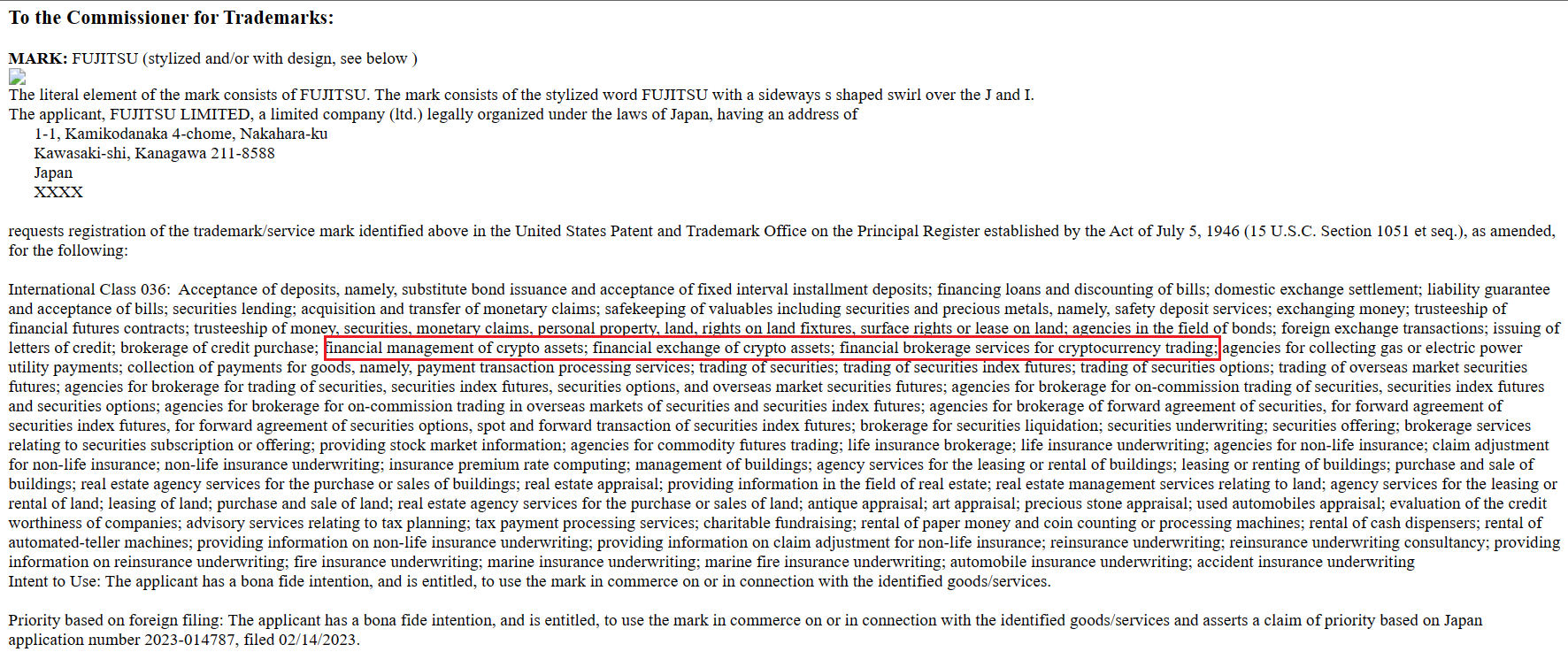
Japanese tech giant Fujitsu filed a trademark application with the United States Patent and Trademark Office (USPTO), revealing its intent to offer brokerage services for cryptocurrency trading, among other crypto and non-crypto financial facilities.
Fujitsu’s trademark application aims to register a new mark which “consists of the stylized word FUJITSU with a sideways s-shaped swirl over the J and I,” according to the official document filed on March 16. The branding is dedicated to offering financial services, including accepting deposits, financing loans, financial management and the exchange of crypto assets.
Fujitsu trademark application filed for the above logo. Source: tsdr.uspto.gov
The image above represents the updated logo Fujitsu intends to trademark for the services. In addition, the snippet below provides an overview of the services Fujitsu disclosed with the USPTO, along with the trademark request.
Fujitsu’s trademark application for crypto services. Source: tsdr.uspto.gov
Fujitsu’s growing interest in Web3 became evident when it launched a Web3 acceleration platform for startups and partner companies in February. The platform aims to support the creation of a diverse ecosystem of Web3 applications across a range of use cases, such as digital content rights management, business transactions, contracts and processes.
Deputy director general of the Financial Services Agency’s Strategy Development and Management Bureau, Mamoru Yanase, acknowledged that the problem wasn’t with crypto. “What’s brought about the latest scandal isn’t crypto technology itself,” he said, adding that the blame lay with “loose governance, lax internal controls, and the absence of regulation and supervision.”