Sunday, September 29, 2019

A Clear Path for Ethereum

An overview of Ethereum starting with its rise, then through the two most significant regulatory events and what future is ahead.

This article provides an overview of Ethereum’s rise, from conception through its initial coin offering (ICO) and beyond. Coinciding with the ICO came attempts to regulate and classify digital currency by multiple governmental and nongovernmental bodies — including the United States Securities and Exchange Commission (SEC), the Commodity Futures Trading Commission (CFTC), the Uniform Law Commission, the Internal Revenue Service (IRS) and the Financial Crimes Enforcement Network (FinCEN). Each has its own opinion on the matter, and as of yet there has been no uniform definition, law or guideline. However, within the regulatory confusion surrounding digital assets on the blockchain, Ethereum enjoys a little clarity.

Section one outlines the rise of Ethereum and its timeline from a business perspective. Section two addresses the regulatory scrutiny that began in 2017 and the confusion resulting from varying perspectives and classifications of digital currencies. Section three provides examples of SEC enforcement of ICOs, and section four details the Howey test and how it applies to ICOs. Sections five and six explain the two most significant regulatory events for Ethereum. Section seven concludes by eliciting the confusion that dominates the digital asset realm yet the surprisingly clear, bright future for Ethereum.

The rise of Ethereum

Ethereum was first described in a white paper by Vitalik Buterin in 2013. It was formally announced at the North American Bitcoin Conference in Miami in 2014 and launched in 2015. However, in 2016 the Decentralized Autonomous Organization (DAO) was hacked, resulting in a $50 million loss to investors. 

In an effort to recover the losses, a majority of the Ethereum community decided in favor of a hard fork, which invalidated the transaction. This led to a split in the Ether. Ethereum (ETH) was used by those in favor of the fork, while Ethereum Classic (ETC) was used by those who continued on the old blockchain. Both are still in use today.

Regulatory scrutiny and confusion

In 2017, Ethereum took off. It had a successful ICO and launched the Enterprise Ethereum Alliance, which is a member-driven standards organization designed to “develop open, blockchain specifications that drive harmonization and interoperability for businesses and consumers worldwide.” 

Months after a formal petition to the SEC for guidance as to what rules pertain to digital assets, on July 25, 2017, the SEC released a statement on the Report of Investigation on The DAO, concluding that all cryptocurrencies could be subject to regulation. The SEC wrote that the requirements apply to those who offer and sell securities in the United States,“regardless whether the issuing entity is a traditional company or a decentralized autonomous organization, regardless whether those securities are purchased using U.S. dollars or virtual currencies, and regardless whether they are distributed in certificated form or through distributed ledger technology.” 

The SEC also specified that “DAO tokens are securities” and that the “foundational principles of the Securities Laws apply to Virtual Organizations or Capital Raising Entities making use of distributed ledger technology.” The SEC further released an Investor Bulletin on ICOs on the same date to make investors aware of the potential risks when considering an investment in an ICO. 

Later, in October of 2017, the CFTC stated that digital tokens may be commodities or derivative contracts, depending on the circumstance, and reasoned that there is no inconsistency between its view and the SEC’s position that some digital currencies can be securities. The CTFC specified that it is the substance not the form of an activity that is considered when applying federal commodities laws and regulations. 

In the same month, the Uniform Law Commission released the Uniform Regulation of Virtual Currency Business Act, which stated that a user who obtains convertible digital currency and uses it to purchase digital goods or services is not considered a money service business.

However, FinCEN concluded that administrators or exchangers of centralized digital currencies and exchangers of decentralized digital currencies are money transmitters and therefore subject to the Bank Securities Act. This means that crypto exchanges are required to register with FinCEN and comply with regulatory rules. 

Meanwhile, the IRS classifies digital currencies as property for tax purposes.

The regulatory landscape for digital blockchain tokens that are not intended to qualify as securities remains unclear. In August 2019, however, SEC Commissioner Peirce announced her support for the establishment of a ‘non-exclusive safe harbor’ exemption from registration. In line with the Commission’s open-door policy, Commissioner Peirce, reinforced the Commission’s desire for feedback from lawyers and industry leaders as to how such a safe harbor could take shape. The safe harbor concept was again reinforced during the SEC Commissioners’ appearance before the U.S. House of Representatives Financial Services Committee in its hearing titled “Wall Street’s Cop on the Beat” on September 24, 2019.  

Related: Why Is the US Not Yet a Leader in Crypto Regulation? Experts Answer

SEC enforcement of ICOs

Since the SEC released its groundbreaking DAO Report 2017, there have been more than 30 SEC enforcement actions against ICO issuers and their officers, as well as countless subpoenas and information requests relating to ICOs. 

On Nov. 8, 2018, the SEC announced that it settled charges against Zachary Coburn, the founder of EtherDelta, who was found to be operating an unregistered national securities exchange and thus in violation of federal securities laws. According to the SEC, EtherDelta is an online platform used for secondary market trading of ERC-20 tokens. This is one of the most popular tokens and, according to Investopedia, “it has emerged as the technical standard used for all smart contracts on the Ethereum blockchain for token implementation.” Further, in its order against Coburn, the SEC stated that ERC-20 tokens are commonly issued in ICOs.

On Nov. 16, 2018, the SEC explained that both CarrierEQ Inc. (Airfox) and Paragon Coin Inc. conducted ICOs in 2017, after the DAO Report, warning that ICOs can be securities. Airfox, a Boston-based startup, raised approximately $15 million worth of digital assets, while Paragon, an online entity, raised approximately $12 million worth of digital assets. Neither company registered their ICOs pursuant to federal securities laws, and they did not qualify for an exemption to the registration requirements. 

Both companies settled with the SEC and agreed to register the tokens as securities. Stephanie Avakian, co-director of the SEC’s enforcement division, warned that the SEC has “made it clear that companies that issue securities through ICOs are required to comply with existing statutes and rules governing the registration of securities,” and it will “continue to be on the lookout for violations of the federal securities laws with respect to digital assets.”

As recently as September 2019, enforcement continues. ICOBox and its founder were sued by the Commission for acting as an unregistered broker-dealer in connection with the platform’s activities and for conducting an illegal $14M unregistered securities offering for its own token, “ICOS.” 

Determination of whether a particular digital asset is a security, and therefore, whether the securities laws apply, is today governed by whether the subject tokens or coins fall under the definition of “security” as defined in the Securities Act of 1933, as amended, and a landmark U.S. Supreme Court case that followed. 

The Howey test, explained

The Howey test is a formula created by the U.S. Supreme Court used to determine whether a transaction qualifies as “investment contract” — therefore a security — and subject to federal securities laws. The Howey test framework derives from the 1946 Supreme Court case SEC v. W.J. Howey Co. and subsequent case law. The Howey case, in particular, involved a Florida citrus farm owner who would sell tracts of farmland to investors who then could choose to lease it back to Howey’s service company, via a service contract to cultivate and harvest oranges on the site. 

The test itself is comprised of four elements. If 1) there is an investment of money; 2) in a common enterprise; 3) with a reasonable expectation of profits; 4) from the efforts of the promoter or third party, then an “investment contract” exists. 

In Howey, the legal question was whether the contracts Howey was selling qualified as securities. Given that those who purchased and leased back the subject farmland did so assuming that it would generate a profit as a result of someone else’s efforts, the court found:

"The transactions in this case clearly involve investment contracts as so defined. The respondent companies are offering something more than fee simple interests in land. [...] They are offering an opportunity to contribute money and to share in the profits of a large citrus fruit enterprise."

Therefore, the offering needed to be registered with the SEC, and Howey violated §5 of the Securities Act of 1933 by failing to do so.

In the digital asset arena, the question becomes whether U.S. federal securities apply when a tokenized digital asset (or the right to acquire a token in the future) is offered, sold or distributed. Taking the analysis a step further involves determining whether the digital asset itself is a security, including an “investment contract.” The present answer for Ethereum is no.

Ethereum is not a security

For Ethereum, the regulatory uncertainty was somewhat abated on June 14, 2018, when the SEC’s Director of Corporation Finance, Mr. William Hinman, stated that Ethereum is currently not a security. He explained that “if the network on which the token or coin is to function is sufficiently decentralized” the assets are not necessarily investment contracts because purchasers would not reasonably expect someone to carry out essential managerial functions. 

In relation to Ethereum specifically, Mr. Hinman stated that the Ethereum network has a decentralized structure, and as such, “current offers and sales of Ether are not securities transactions.” Therefore, “applying the disclosure regime of the federal securities laws to current transactions in Ether would seem to add little value.” To further elicit the reasoning behind his statement, Hinman clarified that “the economic substance of the transaction always determines the legal analysis, not the labels.” 

For example, the oranges in the Howey case had utility. “But Howey was not selling oranges,” he was “selling investments, and the purchasers were expecting a return from the promoters’ efforts,” Mr. Hinman reminded. 

Official relief from SEC enforcement

The July 25, 2019 Pocketful of Quarters No Action Letter from the SEC marked another step toward regulatory clarity for Ethereum and other ERC-20 tokens. The SEC granted no-action relief to Pocketful of Quarters (PoQ) for its ERC-20 token “Quarters,” which means that the SEC will not take enforcement action based on the specific facts and circumstances set forth in the request. This was the first token built according to the ERC-20 standard to receive regulatory approval. 

PoQ is a blockchain startup designed to create a universal gaming token redeemable across any video game platform. It is headed by 12-year-old CEO George Weiksner and his father, PoQ’s chief technology officer, Michael Weiksner. 

One element of the Howey test is a purchaser’s “reasonable expectation of profit” from a transaction. PoQ argued that the gamers on its platform have no such expectations, and the SEC agreed. The letter is a green light for PoQ’s token issuance, and a beacon for other platforms hoping to accomplish the same.

Clarity amid confusion

As of yet, the U.S. government has not exercised its constitutional power to regulate blockchain technology and cryptocurrencies to the exclusion of states. Thus, states are still free to design and enforce their own legislation, and several — including ArizonaConnecticutVermontDelaware and Wyoming — have already done so.

Along with varying state regulations, there is federal confusion. The SEC considers digital currencies as securities if they meet the Howey test, the CFTC considers them commodities and the IRS taxes them as property.

Luckily for Ethereum, Mr. Hinman’s remarks and the PoQ No Action Letter have given it the regulatory clarity and freedom it needs to thrive. Ethereum also enjoys considerable institutional adoption from big names like Amazon, Coinbase, Fidelity, Google, Microsoft and Samsung in varying applications.

Google is pushing developers to build decentralized applications (DApps) on the Ethereum blockchain, while Microsoft is working with the Enterprise Ethereum Alliance to create crypto tokens and has also partnered with ConsenSys to offer Ethereum Blockchain as a Service on Microsoft Azure. With regulatory clarity and institutional support, it seems that Ethereum’s future is bright and boundless.

The views, thoughts and opinions expressed here are the authors alone and do not necessarily reflect or represent the views and opinions of Cointelegraph.

The article is co-authored by Robin Sosnow and Veronica Dunlop.

Robin Sosnow, Esq., J.D., MBA, is the founder and principal of Sosnow & Associates PLLC, an innovative, boutique legal practice in New York City.  She also co-founded the Digital Securities Law Group, another New York City-based joint venture legal practice, which is focused specifically on the blockchain industry. She is a ground floor participant in the equity crowdfunding industry. Sosnow & Associates has worked through all the securities exemptions influenced or created by the JOBS Act and uses a business-minded approach to strategize with clients to promote efficiency, reduce risk and develop cost-effective solutions for their legal needs.

Veronica Dunlop is a legal intern for Sosnow & Associates in her third year at Brooklyn Law School. She plans to sit for the New York state bar in July 2020. Veronica is a Block Center International Business Law Fellow as well as a member of both the Brooklyn Journal of International Law and the Moot Court Honor Society, Appellate Division. Last year, Veronica competed in the Price International Media Law Moot at Oxford University, and this year she will be competing in the Willem C. Vis International Commercial Arbitration Moot at the University of Vienna.


from Cointelegraph.com News https://ift.tt/2mRAVwI

Bitcoin Trading Journal: Veteran Trader Shares Tips on how to Profit from Bitcoin and Altcoin investing

95% of crypto traders lose money 100% of the time. Keeping a trading journal can help investors make better trades and accumulate more Bitcoin.

Successful traders treat trading like a business and part of treating your trading like a business involves keeping a journal. While everyone has a different format and preference, I generally use an Excel spreadsheet to help with calculations and provide organizational clarity.

Crypto investors are always curious about each other's positions and typically these conversations take place in private DMs and telegram chats. The goal here is to provide some transparency on my trading routine and I hope traders find the process of observing each step of every trade educational. 

Trading position sizes are redacted, but they are always calculated based on a 1% portfolio loss using the stop loss and entry as a guide. 

Chainlink (LINK)

Entry: .00016499 Satoshis (sats)

Targets: .00018564 (sats) for an 11% gain near the top of weekly demand zone and .000224 (sats) for a 26% gain near the bottom of blue resistance (see chart). 

I’ve placed a stop loss at .00016064 (sats) which equates to a -2.6% loss.

It’s also good practice to consider the risk to reward ratio when making an investment, especially with altcoins given Bitcoin’s current dominance rate. The risk to reward ratio measures the difference between a trade’s entry point all the way to the stop-loss and sell or take-profit order. 

Comparing these two provides the ratio of profit to loss, or reward to risk. For this trade, it is roughly 4.5 at first target 12.6 at the second target.

As mentioned earlier, position sizes are redacted and each trade exposing the total portfolio to a 1% risk. 

9/13/19

General analysis 

LINK caught my attention on Sept. 9 as it was in a clear corrective downtrend since hitting an all-time high. The blue zone was providing strong support and was effectively the bottom of a descending triangle. LINK price broke down from this zone and retested it a number of times as resistance before moving away. 

The altcoin then bounced off of the key support at .00016499 (sats) and eventually broke down, which became my first area of interest to trade. The green zone was an area of daily demand (.00014863 to .00018564 (sats)) and a break below this would be bearish, and likely lead to further price depreciation.

LINK/BTC Daily Chart. Source: TradingView

LINK/BTC Daily Chart. Source: TradingView

Entry ideas 

If it breaks down here, the first interesting entry would be a breakthrough .00016499 (sats) which would recapture the former support. Ideally one would like to catch a retest, but being willing to potentially trade the breakout with a tight stop was the thought, as LINK tends to really move and punish traders waiting for a clean retest. 

In hindsight, I wish I could have shorted this down as I was very confident that price would drop after losing the blue zone.

If LINK price broke the descending trendline it would be something of a definitive end to the downtrend. A break or retest of this area would become a second trade. 

How it worked out

By Sept. 19 the trade proved to be a success. There were 2 consecutive swing failure patterns (SFP) below the previous swing low at the bottom of the green range with tweezer bottoms on the daily chart. 

Swing failure patterns are identified when price quickly moves to a key swing low (or high for a short), wicks below and closes above. This is an indicator that a whale has pushed price to that level to find liquidity to fill their orders and often referred to as “engineered liquidity.”

LINK/BTC Daily Chart. Source: TradingView

LINK/BTC Daily Chart. Source: TradingView

This was interpreted as a strong reversal signal and was a sign that LINK was about to pump. A full position buy order fired as price broke through the red line and as mentioned before, I chose to play the break out with a preset limit order. 

Sell orders had been set at .000185 (sats) (50%) and .00022 (sats) which was the remaining 50% of the position. I’ve found that putting sell orders lower than the targets helps to avoid being front-run and this is a strategy I employ with all my trades.

LINK/BTC Daily Chart. Source: TradingView

LINK/BTC Daily Chart. Source: TradingView

Overall the trade went great. Both targets were hit and closed 50% of the position at each target. LINK appeared to have more gas in the tank but I chose to stick to the plan. 

I wasn’t looking for re-entry at this time but I would consider a re-entry with a retest of the red line, or a break of the descending line mentioned earlier. This trade produced an 18% profit. 

Bitcoin (BTC)

Since topping out at $13,800, Bitcoin (BTC) has been on a bit of a roller coaster but this doesn’t mean intraday and swing trades can’t be capitalized on. My targets were set at $9,700 through $10,028 and idea entries were at $9,367 and $9,321. 

The risk to reward was 3.1 for the first target and 11.5 for the second target. A stop-loss was placed at $9,260 which equates to a 1.14% and 0.65% loss if that region is hit.

BTC/USD 4hr Chart. Source: TradingView

BTC/USD 4hr Chart. Source: TradingView

General analysis

I chart Bitcoin (BTC) more than any other asset, so I am well tuned to its general movement. Importantly, as an American, I do not trade on any leveraged exchange since I don’t trust them. This means I lack the ability to short even though Kraken readily available. I simply don’t trust the availability of margin or the “scam wicks” that are often seen liquidating and stopping out unassuming traders. 

Bitcoin price has been slowly dropping for days and around Sept 24 it looked ready to fall off of a cliff. That said, there is a very good risk/reward for a long if this is the bottom but one would need a tight stop. 

This is a clear situation of “buying support.” The only issue is that the support has been tested multiple times which tends to make it weaker. The closer to support the better entry to tighten up the stop loss. The channel is also unconfirmed at the bottom and the resistance at the top is clear. 

The red line represents a previous swing low and I want nothing to do with any candle closes below this line because it will clearly invalidate my premise. 

BTC/USD 4hr Chart. Source: TradingView

BTC/USD 4hr Chart. Source: TradingView

Entry idea

The confluence of a key support from the previous swing low ($9,321) and the bottom of the potential channel represents a do or die point and it is very easy to cut bait with a tight stop if this goes the wrong way. 

The risk is having a stop loss fire and this level turning into an SFP with just a wick below the red line. That would be brutal and has happened many times. Setting the stop at $9,260 gives about $60 of leeway below the support for an errant wick.

I decided to spread the orders in a circle and the first wick down filled about 70% of the orders and was followed by a nice bounce. I thought that may have been the end of the dump there, but the rest of my orders filled at the red line. 

Not ideal, I would have rather had the orders all fill on the first drop. The fact that the price bounced and returned to support is bearish but I am sticking to my plan.

BTC/USD 4hr Chart. Source: TradingView

BTC/USD 4hr Chart. Source: TradingView

How it worked out 

The trade was a total train wreck. That was the fastest that I have been stopped out of a trade in a long time, probably under 5 minutes from the second entry. Bitcoin price hit the red line and dumped through it in epic fashion. 

Clearly this was an absolutely awful read on the chart, but luckily a tight stop loss helped to mitigate losses. This would have been extremely ugly without a tight stop, as it ended up being one of the largest red candles in recent Bitcoin memory. This trade led to a loss of 0.9%.

One thing that can be taken away from this experience is that keeping a journal allows a trader to backtest and review candle patterns and support / resistance levels without confirmation bias. This improves the ability to execute and manage future trades.

The views and opinions expressed here are solely those of the (@scottmelker) and do not necessarily reflect the views of Cointelegraph. Every investment and trading move involves risk. You should conduct your own research when making a decision.


from Cointelegraph.com News https://ift.tt/2mbAixM

WATCH: Inside the LatAm Crypto Market With the Founder of SatoshiTango

SatoshiTango founder Marias Bari is bullish on crypto in Latin America.

from CoinDesk https://ift.tt/2mTgyiz

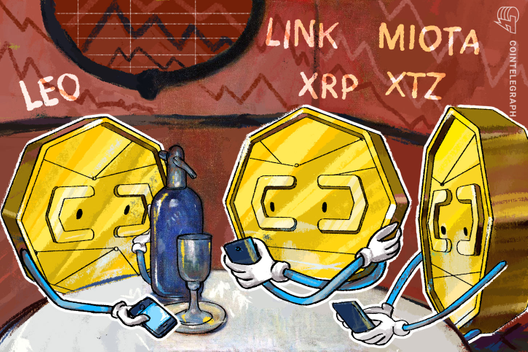
Top-5 Crypto Performers: LEO, LINK. MIOTA, XRP, XTZ

There’s a sea of red across the crypto universe. Do any of the top performers offer a buying opportunity? Let’s study the charts.

Chinese fintech stocks have surged this year on hopes that the launch of a digital currency by the People’s Bank of China will increase demand for security and payment services. Morgan Creek Digital co-founder Anthony Pompliano said that if the digital yuan becomes a reality, it might threaten the dollar’s reign as the global reserve currency. However, he said that even if central banks issue their own digital currencies, people were likely to opt for a currency which cannot be manipulated, seized or censored. 

European Central Bank (ECB) president Mario Draghi has said that the central bank is closely watching developments in the cryptocurrency industry, but has found little value in stablecoins and crypto assets. However, with rapid developments in the crypto industry, he said that the ECB might change its view in the future.

Though Facebook’s Libra is facing stiff opposition from regulators around the world, the company has been working toward allaying their concerns. The social media giant is trying to get its chief operating officer Sheryl Sandberg to testify in front of the House Financial Services Committee. For the long term, the fundamental developments of the asset class are encouraging. 

Nevertheless, the past week has seen a sea of red in the crypto universe. Every major cryptocurrency is in the red over the past seven days. How should traders approach the top performers of this period? Are these outperformers showing signs of a turnaround or will they plunge in the near future? Let’s analyze the charts.

LEO/USD

The best performer of the past seven days is UNUS SED LEO (LEO), which has declined by about 3% during the period. Cryptocurrency exchange Bitfinex has said that owners of LEO will benefit by access to higher allocations during its initial exchange offering compared to others who participate with other cryptocurrencies. Can LEO continue to outperform in the next few weeks? Let’s analyze its chart.

LEO/USD

The LEO/USD pair has been under pressure since topping out at the end of June this year. It has consistently made a lower high and a lower low, which shows that traders are selling on minor rallies. The bulls have been attempting to stall the decline close to $1.0464 for the past three weeks. If successful, the pair might attempt a pullback that will face resistance at $1.36. 

On the other hand, if the support zone at $1.0464–$1.0075 breaks down, it can drop to the next support at $0.80. The bulls are unlikely to buy aggressively if the price slips to new lows and the traders who own positions will bail out of their positions. We will wait for the trend to turn around before suggesting a trade in it. 

LINK/USD

Chainlink (Link) can now be used to pull reliable data about the various pairs traded on Binance. This can come in handy for various innovative decentralized finance applications. The listing on Kraken also helped put a floor beneath the prices. Can it stage a recovery from current levels? Let’s analyze its chart.

LINK/USD

The Link/USD pair has been consolidating between the psychological support of $1.50 and the previous support turned resistance of $2.0531 for the past four weeks. The 20-week EMA has flattened out and the RSI is also close to the midpoint, which suggests a balance between buyers and sellers.

If the bulls can push the price above the overhead resistance of $2.0531, it will indicate buying at lower levels. The next level to watch on the upside is $2.8498, above which the momentum is likely to pick up. Conversely, if the bears succeed in breaking below the support of $1.50, a drop to $1.3139, which is the 78.6% Fibonacci retracement of the entire rally is probable. 

However, we like the way the cryptocurrency has held its support in this pullback. Therefore, traders can initiate long positions on a close (UTC time) above $2.0531 with a stop loss of $1.40.

IOTA/USD

The Iota Foundation has teamed up with the Linux Foundation. Together they will work to advance the development of an interoperable solution set for IoT, Edge and Cloud integration. In another partnership, the foundation joined hands with the European Institute for Technology (EIT) and EIT Climate KIC, to connect and scale sustainable solutions across the continent. With fundamental news backing Iota (MIOTA), can it rally from the current levels? Let’s study its chart. 

IOTA/USD

The bounce from the $0.244553–$0.207622 support zone fizzled out at the 20-week EMA.  Both moving averages continue to slope down marginally and the RSI is in negative territory, which shows that bears have the upper hand.

If the price slides below the support zone, it will be a huge negative because the next support on the downside is way lower at $0.104073. However, as the bulls have been defending the support zone for the past six weeks, the possibility of a breakdown is low.

Conversely, if the bulls defend the zone once again and the IOTA/USD pair climbs above the 50-day SMA, it will signal demand at lower levels. On crossing above $0.385033, a move to $0.541 is possible. There are two ways to trade this. Either buy on a rebound off the support zone, which gives a close stop loss, or wait for the price to rise above $0.335, which shows that the bulls are back in action.

XRP/USD

Ripple, the company behind XRP has acquired Logos Network, a startup that focuses on speed and scalability. The Logos team will join Xpring to develop decentralized financial products. XRP has been a huge underperformer in the past few weeks. Can it stage a turnaround or will it continue to correct? Let’s analyze its chart.

XRP/USD

The pullback in the XRP/USD pair reversed direction from just below the overhead resistance of $0.34229. This shows selling by the bears on minor rallies to strong resistance levels. The bears are currently attempting to sink the pair to new 52-week lows.

If the pair dips and sustains below $0.22, it will complete a descending triangle, which is a bearish pattern. The next support to watch on the downside is $0.19 and if that also cracks, the downtrend can extend to $0.13. The downsloping moving averages and the RSI in the negative territory also show that bears are in command.

Our bearish view will be invalidated if the pair bounces strongly from the current levels and scales above $0.34229.

XTZ/USD

Binance added support to Tezos (XTZ) and trading commenced on Sept. 24. However, the bounce due to the positive news was short-lived as traders used the opportunity to lighten up their positions. Tezos was the fifth-best performer of the past seven days. It slipped about 16% during the period. How does it look on the chart? Let’s find out.

XTZ/USD

The bulls are attempting to defend the critical support of $0.829651. If this support breaks down, the next stop is likely to be $0.650511, which is the 78.6% Fibonacci retracement of the rally and if that level also cracks, a drop to $0.33 will be in the cards. That will bring the large range of $0.33–$1.85 into play.

Conversely, if the XTZ/USD pair bounces off the support at $0.829651, it will act as a higher low. Above $1.20, a rally to $1.85 is likely. If bulls propel the price above this resistance, a new uptrend is likely. 

The views and opinions expressed here are solely those of the author and do not necessarily reflect the views of Cointelegraph. Every investment and trading move involves risk, you should conduct your own research when making a decision.

The market data is provided by the HitBTC exchange.


from Cointelegraph.com News https://ift.tt/2op7mTJ

Crypto Carnage, Zuckerberg Admission, Royal BTC Scam: Hodler’s Digest, Sept. 23–29

Crypto markets reeling after bloodbath sparks major losses, as Zuckerberg admits Libra is “sensitive for society.”

Coming every Sunday, Hodler’s Digest will help you track every single important news story that happened this week. The best (and worst) quotes, adoption and regulation highlights, leading coins, predictions and much more — a week on Cointelegraph in one link.

Top Stories This Week

Crypto carnage: Bloodbath for altcoins as Bitcoin crashes

It’s been a week to forget in the crypto world. Bitcoin (BTC) prices crashed hard on Tuesday — rapidly dropping from $9,800 to $8,150 over the course of the day. The double-digit percentage losses saw the overall crypto market cap lose a whopping $20 billion in less than an hour. While some analysts blamed Bakkt’s sluggish launch for the downturn, others said BTC’s weak market moves may be linked to the political turmoil in the United States, where news of impeachment proceedings against President Donald Trump spooked markets. Altcoins were not immune from Tuesday’s pain — Bitcoin SV (BSV) took a massive hit of more than 34% on the day, while Ether (ETH) sustained heavy losses of 24%. Later in the week, BTC/USD dipped to $7,736 — the lowest price since May 2019. Although some ground was recovered, Bitcoin entered the weekend trading sideways in the low $8,000s.

Zuckerberg: Libra is “sensitive for society” and has no launch date

Facebook CEO Mark Zuckerberg appeared to show a rare display of fear as regulatory scrutiny surrounding the Libra stablecoin intensifies. He admitted the project was “very sensitive for society” and said his company was determined to work through issues before launching. The billionaire also acknowledged this is a very different approach to what Facebook might have done five years ago. In other Libra news this week, reports emerged that the social network’s chief operating officer, Sheryl Sandberg, is in talks to testify in front of the House Financial Services Committee. Meanwhile, Calibra wallet head David Marcus — who has already faced a grilling in front of Congress — asserted in a blog post that blockchain-based payment networks can address inefficiencies in existing payment systems.

Picture 1

Kik founder: We’ll fight SEC “until we don’t have a dollar left”

The CEO and founder of Kik, the Canadian social media and messaging app, had a defiant message for U.S. regulators this week: We’re not going down without a fight. The company has been mired in a costly legal battle with the Securities and Exchange Commission (SEC) over the initial coin offering for its Kin cryptocurrency — with the SEC claiming the $100 million sale was unregistered. Kik’s CEO, Ted Livingston, told a conference in Toronto on Wednesday: “We have to keep going. Until that’s it, we don’t have a dollar left, a person left. We will keep going no matter how hard it is.” Also this week, Livingston confirmed that the company will shut down the Kik app and reduce its headcount from 151 to 19 as it fights for Kin’s survival. The embattled company is hoping to go to trial in May 2020 and is raising $5 million to fund its lawsuit against the SEC.

France: 25,000 major retail stores to accept Bitcoin in 2020

Paris Retail Week brought the news that support for BTC payments is going to be launched at more than 25,000 sales points for 30 French retailers next year. Big brands such as the sportswear giant Decathlon and cosmetics chain Sephora are among those involved in the project. Global POS, the company providing the technology, described it as an “important symbolic step in the evolution of payment methods in France” that will allow businesses to “safely enter the world of Economy 3.0.” Even as thousands of stores embrace crypto, European Central Bank President Mario Draghi continued to be pessimistic about the future of crypto assets — insisting they “are not designed in ways that make them suitable substitutes for money.” On Wednesday, a new survey by Big Four auditor KPMG suggested that 63% of U.S. customers perceive blockchain tokens to be an easy form of payment.

Tron’s Justin Sun to reschedule Warren Buffett launch “very soon”

Justin Sun’s buffet with Buffett has been delayed for some time now. The Tron founder had paid $4.56 million for the privilege during a charity auction in June, but postponed due to medical reasons. Now, Sun is saying he plans to schedule his brunch with the billionaire “very soon” — and he even wants to add other esteemed individuals to the guest list. In a tweet to President Trump, a crypto skeptic, Sun wrote: “Mr. President, you are misled by fake news. #Bitcoin & #Blockchain happens to be the best chance for US! I'd love to invite you to have lunch with crypto leaders along with @WarrenBuffett on July 25. I guarantee you after this lunch, nobody will know crypto more than you!” He hasn’t had a reply yet.

Picture 2

Winners and Losers

At the end of the week, Bitcoin is at $8,058.19, Ether at $167.93 and XRP at $0.24. The total market cap is at $213,108,859,392.

Picture 4

The top three altcoin gainers of the week are Custody Token, XTRD and Tellurion. The top three altcoin losers of the week are Pandacoin, Bitcoin God and Oxycoin.

For more info on crypto prices, make sure to read Cointelegraph’s market analysis. 

Most Memorable Quotations

Picture 3

“We have to keep going. Until that’s it, we don’t have a dollar left, a person left. We will keep going no matter how hard it is.”

Ted Livingston, Kik CEO

“Mr. President, you are misled by fake news. #Bitcoin & #Blockchain happens to be the best chance for US!”

Justin Sun, Tron founder

“The risk is high for a rapid descent down to $4,000 or lower!”

Peter Schiff, gold bug

“Combining the internet with Bitcoin gives us a real chance of achieving the original promise of the internet; freedom of speech, commerce and finance.”

Kim Dotcom, entrepreneur 

“If Libra is introduced, it could have a huge impact on society.”

Haruhiko Kuroda, Bank of Japan governor 

“When we do things that are going to be very sensitive for society, we want to have a period where we can go out and talk about them and consult with people and get feedback and work through the issues before rolling them out.”

Mark Zuckerberg, Facebook CEO

“Bakkt, first day volumes: 71 bitcoin. CME, first day volumes: 5298 bitcoin. That's a 75x difference.”

Alex Kruger, trader

Prediction of the Week

Peter Schiff: Bitcoin price now at “high risk” of $4,000 or lower

A cheery prediction of six-figure BTC prices somehow doesn’t seem appropriate this week. Gold bug Peter Schiff, who has never knowingly passed up an opportunity to bash Bitcoin, has a rather gloomy forecast for the world’s dominant cryptocurrency. After BTC shed $1,800 in a matter of hours, he warned: “The risk is high for a rapid descent to $4,000 or lower!”

FUD of the Week

China’s central bank: Digital currency has “no timetable” for launch

Contradicting previous statements, the People’s Bank of China has now denied that Beijing is ready to launch its digital currency. The state-run Global Times said the delay is because the bank “needs to research, test, evaluate and prevent risks.” Back in August, Deputy Director Mu Changchun had suggested that the project was complete and awaiting launch — perhaps even before the end of 2020. Those comments had sparked suggestions that Beijing was in a race to beat Libra to the punch. With Facebook’s stablecoin bogged down in regulatory red tape, these latest remarks indicate the social network may have a little bit of breathing space.

Fake royal letter asks for $2.5 million in BTC to save U.K.’s economy after Brexit

We’ve seen some audacious scams in our times at CT Towers, but this one takes the cake. Fraudsters have sent out letters in the post to British consumers, posing as senior servants to the Queen, to ask for $2.5 million in BTC to help the United Kingdom maintain the local economy after Brexit. The letter says those who send cryptocurrency will be rewarded with a 30% interest rate for three months — as well as, get this, the honor of becoming a Member of the Royal Warrant Holders Association. Naturally, the letter includes a plea to keep this exclusive offer secret. 

Fake Bitcoin investment platform from “Elon Musk” promises 4,000% ROI

And here’s one more scam that’s worthy of a FUD mention this week. Scammers are using fake mainstream news articles to advertise a nonexistent and potentially dangerous Bitcoin investment platform. The ruse uses celebrity endorsements from the likes of actress Kate Winslet — and even boasts that it has backing from Richard Branson, Elon Musk and Bill Gates. The fraudsters claim that each star bought $10,394 worth of BTC and netted a return of $421,226 — a growth of 4,110% — in the space of a week. Winslet responded angrily to news that her image was used in this way, describing the promotion as “completely disingenuous and categorically false.”

Best Cointelegraph Features

VanEck, SolidX drop Bitcoin ETF race, SEC approval until 2020 unlikely

The Chicago Board Options Exchange’s BZX Equity Exchange has withdrawn its proposal for a VanEck–SolidX Bitcoin exchange-traded fund. The Securities and Exchange Commission still had another month to greenlight or reject the financial product. Stephen O’Neal follows up on the story.

BTC and quantitative easing: What’s the correlation in crypto?

According to some, there’s a connection between Bitcoin and the government’s use of quantitative easing — with crypto prices rising whenever this monetary policy is enforced. Will Heasman explores whether this idea is entirely out of the realm of possibility.

First week of Bakkt: Slow start unlikely to dampen long-term prospects

Kirill Bryanov examines how Bakkt, the first federally regulated platform for Bitcoin futures trading, has performed in its first week.


from Cointelegraph.com News https://ift.tt/2m5QNeB

Crypto in Cuba Faces Challenges Despite Growing Adoption, Overview

While ordinary Cubans are using crypto access the global marketplace, the sector faces a number of challenges.

Following the roll-out of mobile internet across the country in 2018, many ordinary Cubans are increasingly using cryptocurrencies to bypass economic sanctions imposed by the United States and access the global marketplace.

Despite growing adoption, cryptocurrencies still face a number of challenges in Cuba, including limited access to crypto exchanges, lack of a pertinent regulatory apparatus and the growing popularity of a gold-backed MLM stablecoin.

10,000 Cubans use crypto

On Sept. 12, a report published by Reuters included excerpts from an interview with Jason Sanchez, a 35-year-old Cuban who describes virtual currencies as “opening new doors” for ordinary citizens. The Havana resident runs a cell phone repair shop and uses Bitcoin (BTC) to purchase hardware online from China.

According to members of CubaCripto, a Telegram group boasting 600 members and considered to be among the first crypto-oriented online communities in Cuba, cryptocurrencies are increasing in popularity for several utilities. 

While the primary utility of cryptocurrencies cited is their capacity to allow Cubans to circumvent economic sanctions and make purchases online, other members of the local crypto community are looking to virtual currencies for trading and investment purposes, seeking to profit from Bitcoin price volatility. 

Despite Bitcoin’s price fluctuations, some Cubans are also using crypto as a means to store value. Many of CubaCripto’s members also emphasize the privacy benefits to Bitcoin, highlighting that their financial activities are less easily traced by the local government.

Alex Sobrino, the founder of CubaCripto, estimates that 10,000 Cubans regularly use cryptocurrency. According to Alex, ordinary Cubans are using crypto to purchase phone credit, buy goods online, and even make hotel reservations.

Cubans blocked by crypto exchanges

While cryptocurrency is increasing in popularity across cryptocurrency in Cuba, the island’s residents are barred from accessing many virtual currency exchanges. As of July 1, 2019, Binance DEX’s website began to geoblock users with IP addresses originating from 29 countries, including Cuba. 

During May 2018, Bittrex also updated its terms of service to formally block residents of Cuba alongside four other nations subject to U.S. sanctions. In July 2017, a programmer based in the United Kingdom visited Cuba and, upon arriving home, found that his Coinbase account had been blocked after having accessed the account while on the island.

In November 2018, a report published by Mosaic.io found that 19 of 44 cryptocurrency exchanges restricted Cubans from accessing their platform, making Cuba the sixth-most blocked jurisdiction by crypto exchanges, followed by the United States, which is blocked by 30 exchanges, Iran and North Korea with 24, Syria with 23 and Sudan with 20.

CubaCripto members report that there are no traditional exchanges facilitating virtual currency for Cuban fiat currency. As such, many Cubans seeking to purchase crypto must do so via direct face-to-face transactions with local traders in exchange for cash or phone credit.

Accessing crypto in Cuba

Fusyona, a company founded in 2018 seeking to bill itself as Cuba’s first cryptocurrency exchange, does not offer typical order-matching services. Instead, the company acts as a broker between cryptocurrency buyers and individuals located outside of the country who are seeking to remit funds to Cuba, charging a fee of up to 10 percent.

The founder of Fusyona, Adrian Leon, states that for citizens living in developed countries, virtual currencies are “just another option,” while for Cubans, cryptocurrencies comprise a needed solution to Cuba’s “exclusion from the global financial community.” 

At the start of the year, Havana was struck by a devastating tornado that resulted in 3 deaths, 172 injuries and wholesale damage to local properties and infrastructure. Due to the financial embargo maintained against Cuba, GoFundMe and Facebook campaigns seeking to distribute aid to the island’s citizens were shut down.

In response, Fusyona launched a platform through which donations in the form of Bitcoin could be accepted and used to fund the provision of basic goods, including toiletries, water, canned food and powdered milk. The company also donated its profits to the platform during the campaign. Leon estimates that the platform currently has a user base of 1,300 — nearly double its previous count of 700 in July.

Cryptocurrencies are not regulated in Cuba

Despite the growing popularity of crypto in Cuba, no regulatory apparatus exists to legitimize the operations of businesses operating with cryptocurrencies on the island. Fusyona’s founder expressed concerns that his partners who receive and transfer cash might be suspected of engaging in illicit financial activities and has engaged Cuban Central Bank officials for regulatory approval. Due to the lack of regulatory architecture for crypto in Cuba, Fusyona is currently registered in Brazil. 

Professor Alexi Masso Muoz of Havana University’s cryptography institute told Reuters that while no Cuban virtual currency laws currently exist, “it is possible” that the island may soon seek to develop crypto regulations. However, many Cubans fear the government may move to prohibit virtual currencies. On this, CubaCripto’s Alex Sobrino stated:

“We worry the government will restrict us, prohibit things, start to say this is illicit enrichment.”

Crypto gains momentum in Cuba during 2015

While last year’s roll-out of mobile internet was a catalyst for the recent growth in Cuban crypto adoption, virtual currencies have been slowly taking root in Cuba for at least four years following the introduction of public Wi-Fi networks in 2015.

During March 2015, CoinTelegraph interviewed members of Club Anarcocapitalista de Cuba (Cuban Anarchocapitalist Club, or CAC). The group is believed to have been the first entity to accept BTC payments in Cuba, starting from February 2015. The group’s co-founder, Jois Garcia, stated:

“We believe that Bitcoin has an essential role to play within the context of renewed relations between Cuba and the USA. This currency would not be punished like the dollar is today; the dictatorship makes holding dollars a burden, but the introduction of Bitcoin would allow us to potentially dodge this problem.”

Garcia was introduced to Bitcoin by Fernando Villar, a first-generation Cuban American based in New Jersey and the administrator of BitcoinCuba. At the time, Villar described the softening relations between Cuba and the U.S. as providing the catalyst for Bitcoin to “begin to flourish in Cuba,” highlighting that the presence of U.S. telecommunication infrastructure was improving “phone and internet services on the island.”

Despite his optimism regarding Bitcoin’s potential in Cuba, Villar acknowledged that the island’s cryptocurrency scene was in its nascent stages, stating that he was aware of only a single Cuban Bitcoin miner.

Despite the launch of public Wi-Fi, internet access was extremely expensive, with an hour of heavily-censored internet costing $4.50 — nearly 20% of the average Cuban wage at the time. While 37% of Cubans were estimated to have access to the internet in 2015, Freedomhouse found that less than 5% of the island’s residents had access to uncensored internet.

CAC co-founder Nelson Chartrand described the low rates of internet access as the principal barrier to Bitcoin adoption in Cuba during an interview with Vice in June 2015: “A lot of people in Cuba have never actually been online—that’s the big obstacle right now.”

When visiting Cuba during July 2015, Villar was involved in the first publicly executed Bitcoin transfers between Cuba and the United States. In an interview two months later, Villar spoke to the increasing penetration of communication technology in Cuba, stating that more Cubans owned “iPhones and Androids sent from families abroad than have bank accounts.”

Recent reports estimate that 1,400 WiFi hotspots are operational in Cuba, while 80,000 homes have internet access and 2.5 million Cubans have access to 3G mobile internet, the latter equating to nearly 22% of the population.

Gold-pegged stablecoin MLM emerges in Cuba

In addition to leading cryptocurrencies like BTC and Ethereum (ETH), the gold-pegged cryptocurrency and multi-level marketing scheme KaratGold Coin (KBC) is circulating Cuba.

According to a report published by PortalCuba.cu, the members of CubaCripto frequently discuss the price of gold and KBC, with users arguing over whether KBC is a “pyramid scam, multilevel company,” or a source of “residual income for life.” The report describes KBC alongside BTC, ETH and Litecoin (LTC) as among the most popular cryptocurrencies in Cuba. 

Cuba explores state-backed Crypto

At the start of July 2019, Cuba’s government announced via state TV that it was exploring cryptocurrency among other economic measures as a means to boost production and bolster growth. President Miguel Diaz-Canel announced that the new economic measures would raise incomes for a quarter of Cuba’s citizens in addition to facilitating access to foreign investments and the circumvention of U.S. sanctions. Cuba’s economy minister, Alejandro Gil Fernandez, stated: 

“We are studying the potential use of cryptocurrency [...] in our national and international commercial transactions, and we are working on that together with academics.”

Related: McAfee on BTC, Exile & the US: ‘No Way the Current System Can Survive’

Upon hearing of Cuba’s interest in blockchain technology, founder of McAfee and U.S. tax fugitive John McAfee, offered free assistance to the country in developing a virtual currency. In one interview, McAfee stated that creating a coin that is tailored to the economic needs of the country is not an easy task and that he is one of the very few people who can make it happen. Speaking to Cointelegraph while residing in Cuba, McAfee stated:

“Keep in mind Cuba is a very unique country. It’s the only communist country in the Caribbean area — the closest communist country to America. Cryptocurrency has had very little impact on the economy here, on the people. And very few people understand it or know anything about it.”

According to state-backed website Cubadebate.cu, the Central Bank of Cuba is currently examining the risks and benefits associated with virtual currencies.


from Cointelegraph.com News https://ift.tt/2mPqQjR

Is XRP a Security? We May Never Know

A class action lawsuit against Ripple Labs Inc. alleging that XRP is an unregistered security faces another setback.

The discourse surrounding the securities laws and the treatment of digital assets continues to draw debate among market participants, regulators and legal practitioners. One of the most high-profile targets in this ongoing debate is XRP, a digital asset issued by Ripple Labs Inc

Despite voluminous public examination, regulators have not reached a consensus on the appropriate treatment for this widely traded digital asset. Amid vociferous debate and clamoring from market participants for clear, concise and practical guidance from the United States Securities and Exchange Commission (SEC), the commission’s approach to the digital asset space to date has been notably sparse and cautious. 

However, we are currently enjoying a flurry of recent guidance. In April of this year, the SEC published the “Framework for Investment Contract Analysis of Digital Assets,” drawing heavily on a June 14, 2018 speech by William Hinman (the director of the corporation finance division of the SEC) on digital asset transactions. 

This suggests some hope that the SEC’s reluctance to embrace and promulgate digital asset guidance may be waning. This historical reluctance is made all the more apparent when compared with the vigor with which the Commodity Futures Trading Commission (CTFC) and the Financial Crimes Enforcement Network (FinCEN) have waded into the digital asset discussion, publishing numerous guides, interpretive letters and proposed rules.

Nevertheless, a pending class action lawsuit against Ripple has the potential to offer a glimmer of regulatory clarity with respect to the fundamental question that continues to disorder the digital asset ecosystem: When is a digital asset a security? 

Security criteria: The Howey test

The Ripple lawsuit is slowly winding its way through the federal court system. Owing largely to procedural jostling, the plaintiffs in the case submitted an amended complaint on Aug. 5, to which Ripple responded on Sept. 19 with a motion to dismiss. Among other things, the plaintiffs allege that Ripple has raised hundreds of millions of dollars through the sale of XRP — an asset that the plaintiffs allege is an unregistered security — to retail investors in violation of the registration provisions of federal and state securities laws.

In addition to claiming that XRP constitutes a security under California law, the plaintiffs in the Ripple case argue that XRP is a security under the SEC’s long-standing “investment contract” analysis promulgated under 1946 case of the SEC v. W.J. Howey Co., 328 U.S. 293 — i.e., the Howey test). 

Whether any asset (including a digital asset) constitutes an investment contract — and thus a security under the Howey test — is determined by the satisfaction of the following four elements: 1) an investment of money, 2) in a common enterprise, 3) with a reasonable expectation of profits, 4) to be derived from the efforts of others

The plaintiffs, in asserting their case, borrow heavily from the aforementioned SEC framework, quoting from it extensively.

The SEC framework, mentioned above, suggests, perhaps rather evidently, that “the first prong of the Howey test is typically satisfied in an offer and sale of a digital asset because the digital asset is purchased or otherwise acquired in an exchange for value.” The plaintiffs echo this sentiment and claim that XRP clearly satisfies the first prong of the Howey test. 

With respect to the second prong of the Howey test, the plaintiffs argue that purchasers of XRP have clearly invested in a “common enterprise,” acknowledging Ripple’s own concession that it “sells XRP to fund its operations and promote the network.” (Editor’s note: The original website that included this quote was taken down sometime after the lawsuit referenced it, meaning it is only accessible as an archive here).

The plaintiffs argue that the price of XRP is clearly dependent — at least, on some level — on the development, adoption and efficacy of XRP Ledger. Did the plaintiffs purchase XRP with a reasonable expectation of profit? The plaintiffs argue, yes. 

The SEC framework provides a litany of characteristics that indicate a reasonable expectation of profits. XRP, according to the plaintiffs, ticks many of these boxes: XRP is available for trading on secondary markets, XRP is offered broadly to potential purchasers rather than targeted users, the issuer (i.e., Ripple) expends funds from proceeds or operations to enhance the functionality or value of the network of the digital asset, and so on. 

Lastly, drawing again from the SEC framework, the plaintiffs argue that any such profits are clearly derived from the efforts of others — i.e., Ripple itself. The plaintiffs argue that purchasers reasonably expected Ripple and its employees to provide significant managerial efforts, develop and improve the XRP ledger, develop the network, and work to expand secondary trading of XRP.

New turn in the Ripple case

Ripple’s Sept. 19 response seeks to dismiss the complaint largely on procedural grounds, arguing in part that the plaintiffs’ claims are barred by Section 12(a)(1) of the Securities Act of 1933, which imposes a three-year limitation on claims involving the sale of unregistered securities. 

While Ripple only briefly touched on its argument that XRP is not an investment contract and therefore not a security, it does make a point to criticize the plaintiffs’ heavy reliance on the SEC framework — highlighting the fact that the framework explicitly states that it is “not a rule, regulation, or statement of the Commission” and is not binding on the commission or otherwise.

While this latest turn in the Ripple case casts doubt on when and if it will ever reach trial, its outcome could have profound effects, not only for Ripple and other entities that have facilitated — and continue to facilitate — the secondary market trading of XRP, but also for other issuers of similarly situated digital assets. 

In short, if the plaintiffs are able to overcome Ripple’s motion to dismiss and the case were to result in a finding that XRP is a security, it would effectively prohibit secondary trading of XRP, radically alter the legal framework within which many trading venues currently operate, and ultimately imperil Ripple’s economic viability.

Regulatory and practical implications

Historically, Ripple has not treated XRP as a security. It was not offered to the general public pursuant to the registration provisions of the Securities Act. While exemptions from the registration provisions of the Securities Act exist (such as Regulation A), XRP was not offered pursuant to any such exemption and would therefore constitute an illegal securities offering. 

In addition, many of the most popular digital asset trading venues that facilitate secondary trading in XRP are not currently registered with the SEC as broker-dealers and therefore do not possess the regulatory authority to offer secondary trading in digital asset securities. Based on this fact, as well as the fact that XRP would constitute an illegal unregistered security, these venues would be forced to immediately delist XRP. 

However, the ramifications to existing trading venues would extend far beyond an obligation to delist XRP — by having sold XRP and facilitated secondary market trading in the past, these venues will have violated Section 15(a)(1)

This provision of the Securities Act makes it unlawful for any broker or dealer to effect any transaction in — or to induce or attempt to induce the purchase or sale of — any security unless such entity is registered with the SEC. 

Ripple, as well as other entities supporting the secondary market trading of XRP, may also find itself subject to civil and criminal penalties pursuant to Section 20(e), which provides the SEC the authority to assess penalties against entities that are seen to aid or abet an unregistered broker-dealer.

While the foregoing regulatory consequences are no doubt significant, they are by no means exhaustive. Section 29(b) provides the ability, as an option of the investor, to void any transaction made in violation of any provision of the Exchange Act (including Section 15(a)(1)) and further provides each such investor or purchaser a right of rescission. 

State “blue sky” laws also acknowledge and provide for such rights. The practical implication of a violation of Section 29(b) is that purchasers of XRP will have the right to redeem the amounts they have paid for XRP from Ripple as well as potentially from the various venues through which they have bought XRP. 

Given the active trading market that exists for XRP — as well as additional complicating factors, such as the fact that many venues allow customers to buy and sell digital assets using other digital assets (i.e., not fiat currency) — verifying, coordinating and satisfying rescission requests would constitute a monumental, if not impossible, undertaking. 

In fact, history shows us that the financial and administrative complexities of rescission can have deleterious effects on issuers. For example, Neogenix Oncology Inc. was an otherwise successful biotechnology company that was forced into bankruptcy after it was discovered that it had used unregistered broker-dealers during its early capital-raising activities, implicating Section 29(b) of the Exchange Act. The substantial rescission liability, as well as the accompanying administrative complexities of quantifying its total exposure, ultimately impeded additional capital raising and led to its filing for Chapter 11 bankruptcy.

Fueled in part by the SEC’s recent framework, the plaintiffs in the Ripple case have made a compelling argument that XRP is a security. As evidenced by the aforementioned collection of legal and practical implications, such a determination could spell the beginning of the end for Ripple and ensnare a number of market participants in a legal and regulatory quagmire. In fact, the commission’s recently filed action against ICOBox — a provider of initial coin offering marketing services, which the commission alleges sold and marketed unregistered digital asset securities and acted as an unregistered broker-dealer, among other things — may provide a preview, albeit on a smaller scale, of the regulatory and economic fallout from such a determination. 

Should the Ripple case proceed to trial, we imagine that the practical, economic and market implications of such a determination will weigh heavily on the court. While the Ripple case may yet succumb to procedural extirpation, it serves to highlight the regulatory uncertainty that continues to afflict various aspects of the digital asset market and the need for continued, thoughtful, more specific and expanded commission guidance.

The views, thoughts and opinions expressed here are the authors alone and do not necessarily reflect or represent the views and opinions of Cointelegraph.

Ethan Silver, partner and chair of Lowenstein Sandler’s Broker-Dealer practice based in New York, leads an emerging practice group representing regulated financial technology companies, including mobile-first brokerage platforms, robo-advisers and cryptocurrency-focused businesses.

William Brannan, counsel at Lowenstein Sandler in New York, advises technology-focused broker-dealers, digital asset businesses and hedge funds navigating complex securities, derivatives and emerging cryptocurrency regulatory frameworks.


from Cointelegraph.com News https://ift.tt/2mFNv2c